A hair graft is a follicular unit composed of 1 to 4 naturally grouped hairs.
For a successful transplant in Geneva as elsewhere, the number of grafts needed varies according to the stage of baldness assessed by the Norwood scale, the density of the donor area and the desired coverage.
Commonly used ranges: 1,000 to 2,500 grafts for early stages (Norwood 2-3), 2,500 to 4,000 for intermediate stages (Norwood 4-5), up to 6,500 grafts for advanced baldness.
A patient's transplantable blood supply is limited: on average, fewer than 7,000 grafts are available over a lifetime. The FUE technique, performed by Dr. Raphaël Meyer at the Croix d'Or Hair Clinic in Geneva, extracts follicles one by one with a survival rate usually exceeding 95%.
- What is a hair transplant?
- Norwood stage estimation (men)
- What about women?
- The donor area: your hair capital
- The number of hairs per graft
- The FUE technique and implantation quality
- Is there a maximum number of grafts per session?
- Why do the grafts fall out after transplantation?
- Frequently Asked Questions
- Get a personalized estimate
What is a hair transplant?
A graft contains 1 to 4 hairs, or on average 2 to 3 hairs per follicular unit. This is why the number of grafts and the number of transplanted hairs are two different figures: 2,000 grafts can represent between 3,000 and 6,000 hairs depending on their composition.
Hair thickness, texture, and color also play a role: wavy or thick hair provides better coverage than fine, straight hair, which can reduce the number of grafts needed for a visually dense result.
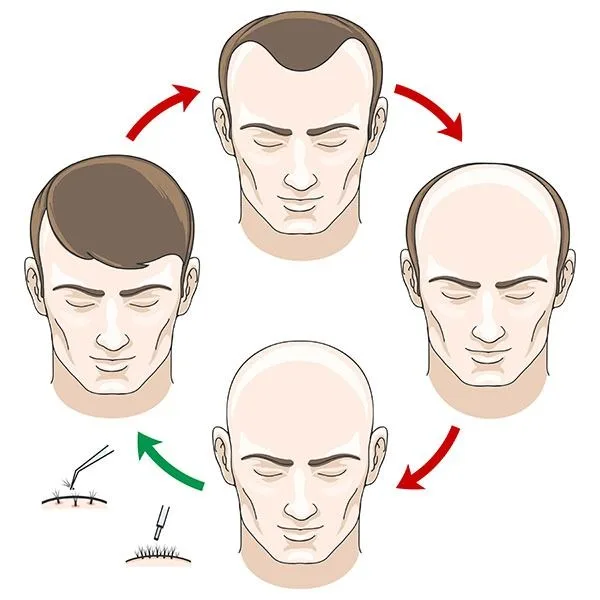
How many grafts depending on your stage of baldness?
Norwood stage estimation (men)
The Norwood scale is the international reference tool for assessing the degree of male pattern baldness. It ranges from stage 1 (intact hair) to stage 7 (advanced baldness). Here are the estimates used in clinical practice, in line with the recommendations of the ISHRS :
| Norwood Stadium | Bare area | Estimated grafts | |||||
|---|---|---|---|---|---|---|---|
| Norwood 2 | Mild temple recession | 500 - 1,000 | |||||
| Norwood 3 | Marked temporal grafts | 1 000 - 2 000 | |||||
| Norwood 4 | Severe recession + thinning of the vertex | 2 000 - 3 000 | |||||
| Norwood 5 | Extensive areas of baldness | 3 000 - 4 000 | Norwood 6 | Frontoparietal junction | 4,000 - 5,000 | ||
| Norwood 7 | Advanced calvitis, residual crown | 5,000+ (sometimes 2 sessions) |
These figures are estimates. Only a consultation with recipient area mapping and donor area analysis will give a realistic range for your situation.
What about women?
In women, hair loss is assessed using the Ludwig scale, which identifies three stages of diffuse alopecia. Graft volumes are generally lower than in male cases, between 1,000 and 2,500 grafts, as loss is rarely total and the donor area often limited. The online diagnosis from the Clinique du Cheveu provides initial guidance.
What determines the number of grafts needed?
The donor area: your hair capital
The donor area is the region at the back and sides of the skull that is genetically resistant to DHT, the hormone responsible for male pattern baldness. It is not unlimited: the average graftable capital is estimated at less than 7,000 grafts over a lifetime.
Exceeding this threshold or harvesting too densely can compromise the appearance of the donor area. This is why sessions are planned carefully, anticipating the future evolution of baldness, particularly in younger patients.
The number of hairs per graft
On average, a graft contains 2 to 3 hairs. This figure depends on the follicular density of the patient and the donor area. Heavy-gauge hair, such as frizzy or wavy hair, provides better visual coverage and reduces the number of grafts needed for a satisfactory result.
The FUE technique and implantation quality
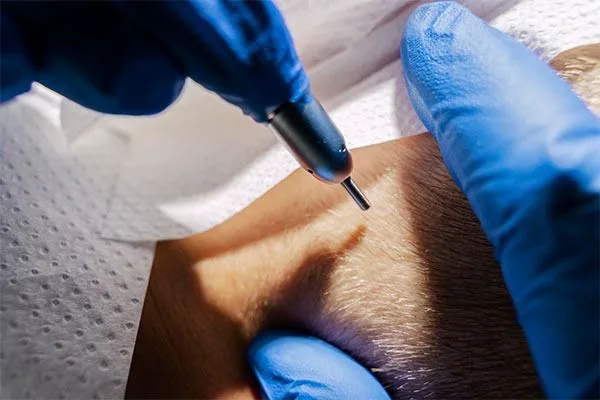
With the FUE hair transplant performed by Dr Raphaël Meyer at the Clinique du Cheveu Croix d'Or in Geneva, grafts are extracted one by one using a micropunch, with no visible linear scar. This approach preserves the appearance of the donor area and achieves a follicle survival rate of over 95% when performed correctly.
Is there a maximum number of grafts per session?
In practice, a single FUE session yields between 500 and 4,000 grafts, sometimes up to 5,000 in cases of mega-sessions for advanced baldness. Beyond a certain volume, a second session spaced 12 to 18 months apart may be scheduled.
Younger patients (under 30) are often advised not to exceed 2,500 grafts in the first session. The duration of the procedure is directly related to the volume: 1 day if fewer than 2,500 grafts, 2 days if more than 2,500 grafts.
Why do the grafts fall out after transplantation?
In the 2 to 6 weeks following the procedure, it is common to see the transplanted hairs fall out. This phenomenon is called shedding, or post-transplant effluvium. It affects the majority of patients and does not mean that the transplant has failed.
What falls out are the hair shafts. The follicles, however, remain anchored in the scalp and enter a resting phase (telogen phase) before resuming their growth cycle. Visible regrowth generally begins around the 3rd or 4th month, and final density is achieved at 9-12 months.
A minority of patients do not experience shedding and see their transplanted hairs grow directly. In both cases, the final result is equivalent.
Frequently Asked Questions
How many hairs are recovered after a transplant of 2,000 grafts?
Does the result depend solely on the number of grafts?
How long do the grafts last?
Is it possible to have multiple transplants during one's lifetime?
How much does a transplant cost depending on the number of grafts?
What is the long-term result?
Get a personalized estimate
The number of grafts you need depends on the stage of your hair loss, the density of your donor area, and your goals. Use the online diagnostic tool for an initial assessment, or schedule a hair consultation in Geneva with Dr. Raphaël Meyer, a hair transplant specialist in French-speaking Switzerland.

Book your appointment today
Make an appointment today for personalized and high-quality aesthetic care. Our team of experts is here to offer you innovative treatments tailored to your needs.
- By phone at +41 22 736 50 50
- Or directly via our online contact form
- Don't miss our exclusive offers and news! Subscribe to our newsletter now and get the latest news.